Input File
Description of the input file, cryspy.in.
Description of the input file, cryspy.in.
CrySPY uses the configparser module to read input file, cryspy.in .
cryspy.in consists of sections, led by a [section] header and followed by name = value or name : value entries.
Section names and values are case sensitive, but names are not.
Lines beginning with # or ; are ignored and may be used to provide comments.
Accepted bool values are 1, yes, true, and on, which cause this method to return True,
and 0, no, false, and off, which cause it to return False.
These string values for bool are checked in a case-insensitive manner.
Some values are given in a space-separated manner.
See configparser in detail.
section name: case sensitive
name: case insensitive
value: case sensitive except for bool
2025 March 6 updated
| Name | Value | Default | Description |
|---|---|---|---|
algo | RS, EA, EA-vc, BO, LAQA | Algorithm | |
calc_code | VASP, QE, OMX, soiap, LAMMPS, ASE | Caluculation code for structure optimization | |
tot_struc | int | The total number of structures. Not used in the case of EA or EA-vc. | |
nstage | int | The number of stages | |
njob | int | The number of jobs running at the same time. | |
jobcmd | str | Command to submit jobs such as qsub and sbatch. | |
jobfile | str | File name of the job file. |
Last updated: October 16, 2026
| Name | Value | Default | Description |
|---|---|---|---|
struc_mode | crystal, mol, mol_bs | crystal | Structure generation mode |
atype | atomic symbol [atomic symbol …] | Atom type. e.g. atype = Na Cl. | |
nat | int [int …] | The number of atoms corresponding to each atype. e.g. nat = 8 8. Not used in EA-vc. | |
mindist (mindist_?) | float [float …] | None | Constraint on minimum interatomic distance [Å]. See Features > Restriction on Interatomic Distances for details. |
mindist_factor | float | 1.0 | Scaling factor for mindist. |
vol_factor | float | 1.1 | Volume scaling factor. |
vol_mu | float | None | Mean of the normal distribution used to sample the cell volume [ų]. If specified, vol_sigma is also required. |
vol_sigma | float | None | Standard deviation of the normal distribution for the cell volume [ų], used together with vol_mu. |
symprec | float | 0.01 | Precision for symmetry finding. |
spgnum | all, space group number, 0 | all | Constraint on space group. If all, 1–230. If 0, random structure without space group information (no symmetry). |
use_find_wy | bool | False | Structure generation with find_wy. |
if algo is EA-vc
| Name | Value | Default | Description |
|---|---|---|---|
ll_nat | int [int …] | Lower limit of nat. e.g. ll_nat = 0 0. | |
ul_nat | int [int …] | Upper limit of nat. e.g. ul_nat = 8 8. | |
charge | int or grouped ints | None | Charge of each atom type used to impose charge neutrality, specified in the same order as atype. For example, charge = 1 -1 for NaCl. Since version 1.5.0, multiple oxidation states can be grouped in parentheses or square brackets. For example, charge = (2 3) -2 for atype = Fe O. See Charge Neutrality Condition for details. |
cn_mode | auto, enumerate, sample | auto | (since version 1.5.0) Used only when charge is specified. Mode for calculating atom-count combinations that satisfy the charge-neutrality condition. |
max_cn_grid_points | int | 200_000_000 | (since version 1.5.0) Used only when charge is specified. Maximum number of combinations examined exhaustively with cn_mode = auto or enumerate after eliminating one atom-count variable using the charge-neutrality equation. If this value is exceeded, auto switches to sampling, while enumerate raises an error. See Charge Neutrality Condition for details, including how combinations are counted for multi-valence species. |
min_comp | float [float …] | None | (since version 1.5.0) Used to impose composition constraints. Specifies the lower bound of the normalized composition (from 0 to 1) for each atom type. Specify one value per atom type in the same order as atype. If only max_comp is specified, min_comp is set to 0.0 for every atom type. |
max_comp | float [float …] | None | (since version 1.5.0) Used to impose composition constraints. Specifies the upper bound of the normalized composition (from 0 to 1) for each atom type. Specify one value per atom type in the same order as atype. If only min_comp is specified, max_comp is set to 1.0 for every atom type. |
if struc_mode is mol or mol_bs
Molecular crystal structure generation (struc_mode = mol or mol_bs) is not supported in EA or EA-vc.
| Name | Value | Default | Description |
|---|---|---|---|
mol_file | str [str …] | Path of molecule files or molecule names. | |
nmol | int [int …] | The number of molecules. | |
timeout_mol | float | None | (removed in version 1.5.0) Time out for molecular structure generation. |
rot_mol | random, random_mol, random_wyckoff | random_wyckoff | Only used in mol_bs. Mode for rotation of molecules. |
nrot | int | 20 | Only used in mol_bs. Maximum number of trials to rotate molecules. |
mindist_mol_bs (mindist_mol_bs_?) | float [float …] | None | Only used in mol_bs. Constraint on minimum intermolecular distance [Å]. |
mindist_mol_bs_factor | float | 1.0 | Only used in mol_bs. Scaling factor for mindist_mol_bs. |
if use_find_wy is True or spgnum = 0
| Name | Value | Default | Description |
|---|---|---|---|
fwpath | str | None | Only used with find_wy. Path of find_wy. If None, fwpath is automatically searched in your $PATH. |
minlen | float | Only used with find_wy or spgnum = 0. Minimum length of lattice vector [Å]. | |
maxlen | float | Only used with find_wy or spgnum = 0. Maximum length of lattice vector [Å]. | |
dangle | float | Only used with find_wy or spgnum = 0. Delta angle for alpha, beta, and gamma in degree unit. | |
maxcnt | int | 50 | Only used with find_wy or spgnum = 0. Maximum number of trials to determine atom positions. |
Last updated: October 12, 2026
[VASP] section is required only if you use VASP (calc_code = VASP)
| Name | Value | Default | Description |
|---|---|---|---|
kppvol | int [int …] | Target k-point grid density for each stage (number of k-points per Å⁻³ of reciprocal-space volume). | |
force_gamma | bool | False | If true, force gamma-centered mesh. |
vasp_MAGMOM | float [float …] | None | Used only for EA-vc. MAGMOM values for each element. |
vasp_LDAUL | int [int …] | None | Used only for EA-vc. LDAUL values for each element. |
vasp_LDAUU | float [float …] | None | Used only for EA-vc. LDAUU values for each element. |
vasp_LDAUJ | float [float …] | None | Used only for EA-vc. LDAUJ values for each element. |
[QE] section is required only if you use QE (calc_code = QE)
| Name | Value | Default | Description |
|---|---|---|---|
kppvol | int [int …] | Target k-point grid density for each stage (number of k-points per Å⁻³ of reciprocal-space volume). | |
qe_infile | str | File name of QE input file. | |
qe_outfile | str | File name of QE output file. | |
pv_term | bool | False | If true, read enthalpy instead of total energy. |
[OMX] section is required only if you use OpenMX (calc_code = OMX)
| Name | Value | Default | Description |
|---|---|---|---|
kppvol | int [int …] | Target k-point grid density for each stage (number of k-points per Å⁻³ of reciprocal-space volume). | |
OMX_infile | str | File name of OpenMX input file. | |
OMX_outfile | str | File name of OpenMX output file. | |
ValenceElectrons | str float float [str float float …] | The number of initial charges for up and down spin states. |
e.g. in NaCl: ValenceElectrons = Na 4.5 4.5 Cl 3.5 3.5.
[soiap] section is required only if you use soiap (calc_code = soiap)
| Name | Value | Default | Description |
|---|---|---|---|
soiap_infile | str | File name of soiap input file. | |
soiap_outfile | str | File name of soiap output file. | |
soiap_cif | str | File name of soiap CIF-formatted initial structure. |
[LAMMPS] section is required only if you use LAMMPS (calc_code = LAMMPS)
| Name | Value | Default | Description |
|---|---|---|---|
lammps_infile | str | File name of LAMMPS input file. | |
lammps_outfile | str | File name of LAMMPS output file. | |
lammps_potential | str [str …], None | None | Potential. |
lammps_data | str | File name of LAMMPS data file. |
[ASE] section is required only if you use ASE (calc_code = ASE)
| Name | Value | Default | Description |
|---|---|---|---|
ase_python | str | File name of ASE input file. |
Last updated: October 12, 2026
[EA] section is required when using EA or EA-vc, or when append_struc_ea = True is specified in the [option] section.| Name | Value | Default | Description |
|---|---|---|---|
n_pop | int | Population (see also Population Size) | |
n_crsov | int | Number of offspring created by crossover | |
n_perm | int | Number of offspring created by permutation | |
n_strain | int | Number of offspring created by strain | |
n_rand | int | Number of structures created randomly | |
n_elite | int | Number of elite individuals (see also Natural Selection) | |
fit_reverse | bool | False | If False, minimal search (see also Evaluate Fitness) |
n_fittest | int | 0 | Number of individuals that remain natural selection. If set to 0, all individuals are retained. |
slct_func | TNM, RLT | Function to select parents | |
t_size | int | 3 | Tournament size. Used only used slct_func = TNM. (see also Tournament Selection) |
a_rlt | float | 10.0 | Parameter for linear scaling. Used only with slct_func = RLT. (see also Roulette Selection) |
b_rlt | float | 1.0 | Parameter for linear scaling. Used only with slct_func = RLT. (see also Roulette Selection) |
crs_lat | equal, random | random | How to mix lattice vectors (see also crossover > 5. Swap the sliced halves) |
nat_diff_tole | int | 4 | Tolerance for difference in the number of atoms in crossover. (see also crossover > 6. Select the offspring with more atoms) |
ntimes | int | 1 | Number of times in permutation. |
sigma_st | float | 0.5 | Standard deviation for strain. |
maxcnt_ea | int | 50 | Maximum number of trials in EA. |
max_parent_attempts | int | 50 | (since version 1.5.0) Maximum number of parent-selection attempts per offspring in EA. The initial parent selection is included. |
maxgen_ea | int | 0 | Maximum generation. If set to 0, no upper limit is applied. |
emax_ea | float | None | Energy upper limit (eV/atom) for natural selection. |
emin_ea | float | None | Energy lower limit (eV/atom) for natural selection. |
emax_ea and emin_ea are used not in natural selection but when computing the convex hull.| Name | Value | Default | Description |
|---|---|---|---|
n_add | int | Number of offspring created by addition. | |
add_max | int | 5 | (since version 1.4.1) Maximum number of atoms to add in addition |
n_elim | int | Number of offspring created by elimination. | |
elim_max | int | 5 | (since version 1.4.1) Maximum number of atoms to eliminate in elimination |
n_subs | int | Number of offspring created by substitution. | |
subs_max | int | 3 | (since version 1.4.1) Maximum number of atoms to substitute in substitution |
ref_energies | float [float …] | (since version 1.5.0) Reference energies for formation energy calculation [eV/atom]. Specify one value per atom type in the same order as atype, separated by spaces without parentheses or commas. The number of values must match the number of atom types in atype. | |
end_point | float [float …] | (deprecated since version 1.5.0) Kept for backward compatibility. Use ref_energies instead. Uses the same units and input format as ref_energies. | |
emax_ea | float | None | Energy upper limit (eV/atom) for computing the convex hull. |
emin_ea | float | None | Energy lower limit (eV/atom) for computing the convex hull. |
cgen was deprecated in version 1.5.0.| Name | Value | Default | Description |
|---|---|---|---|
cgen | int | None | (in versions 1.4.1–1.4.3) Which generation’s data to plot up to. If None, data will be plotted up to the latest generation. |
show_max | float | 0.2 | When plotting the convex hull, the maximum value of the y-axis (for binary systems) or the maximum hull distance (for ternary systems) is set by show_max. |
label_stable | bool | True | Whether to show stable compositions when plotting the convex hull. |
vmax | float | 0.2 | Maximum value of the colorbar representing hull distance. |
bottom_margin | float | 0.02 | Bottom margin of the y-axis for binary convex hull plot. |
fig_format | str | svg | Figure format for convex hull plot: svg, png, or pdf. |
Last updated: October 12, 2026
[BO] section is required only if you use BO (algo = BO)
| Name | Value | Default | Description |
|---|---|---|---|
nselect_bo | int | The number of structures to be selected at once. | |
score | TS, EI, PI | Acquisition function. | |
num_rand_basis | int | 0 | If 0, Gaussian process. The number of basis function. |
cdev | float | 0.001 | Cutoff of deviation for standardization. |
dscrpt | FP | Structure descriptor. | |
max_select_bo | int | 0 | Maximum number of selection. |
manual_select_bo | int [int …] | None | Structure IDs to be selected manually. |
emax_bo | float | None | Upper limit of energy in BO. |
emin_bo | float | None | Lower limit of energy in BO. |
if dscrpt is FP
CrySPY 1.3.0 or later
fppath and fp_rmin are obsolete.
| Name | Value | Default | Description |
|---|---|---|---|
fp_rmax | float | 8.0 | Only used with dscrpt = FP. Maximum cutoff of r in fingerprint. |
fp_npoints | int | 20 | Only used with dscrpt = FP. Number of discretized points for each pair in fingerprint. |
fp_sigma | float | 0.7 | Only used with dscrpt = FP. Sigma parameter [Å] in Gaussian smearing function. |
CrySPY 1.2.5 or earlyer
| Name | Value | Default | Description |
|---|---|---|---|
fppath | str | None | Only used with dscrpt = FP. Path of cal_fingerprint. If None, fwpath is automatically searched in your $PATH. |
fp_rmin | float | 0.5 | Only used with dscrpt = FP. Minimum cutoff of r in fingerprint. |
fp_rmax | float | 5.0 | Only used with dscrpt = FP. Maximum cutoff of r in fingerprint. |
fp_npoints | int | 20 | Only used with dscrpt = FP. Number of discretized points for each pair in fingerprint. |
fp_sigma | float | 1.0 | Only used with dscrpt = FP. Sigma parameter [Å] in Gaussian smearing function. |
[LAQA] section is required only if you use LAQA (algo = LAQA)
| Name | Value | Default | Description |
|---|---|---|---|
nselect_laqa | int | The number of structures to be selected at once. | |
wf | float | 0.1 | Weight of the force term. |
ws | float | 10.0 | Weight of the stress term. |
See also Search algorithms > LAQA
If algo = LAQA, the followings are automatically set in the [option] section.
Force and stress data are collected step by step.
By default, energy and structure data are collected and saved for each selection, at the end of each structure’s optimization run.
The number of optimization steps per selection is specified in the calculation code’s input settings, such as nstep in QE or NSW in VASP. The tutorial uses 10 steps per selection.
To also collect and save energy and structure data at every step, add the following settings:
Last updated: October 12, 2026
The [visual] section is available since version 1.5.0.
Common variables for RS, EA, EA-vc.
See also
| Name | Value | Default | Description |
|---|---|---|---|
ymax | float | 0.2 | Maximum value of the y-axis in the energy plots of RS, EA, and EA-vc (binary systems). |
markersize | int | 10 | Size of markers in all energy plots. |
fig_format | str | svg | Figure formats: svg, png, or pdf. |
See also CrySPY > Tutorial > Evolutionary Algorithm (EA) > Analysis and visualization.
| Name | Value | Default | Description |
|---|---|---|---|
ref_gen | int | None | [post-analysis only] Reference generation for plotting. When specified, the plot is generated as of the end of this generation. If not specified, the latest generation is used. Must satisfy plot_max_gen <= ref_gen. |
plot_min_gen | int | None | [post-analysis only] Minimum generation for plotting. If not specified (i.e., None), the value is treated as 1. |
plot_max_gen | int | None | [post-analysis only] Maximum generation for plotting. If omitted, plotting extends through ref_gen when specified; otherwise, it extends through the latest generation. |
See also CrySPY > Tutorial > Variable-composition evolutionary algorithm (EA-vc) > Analysis and visualization for the convex hull plot.
| Name | Value | Default | Description |
|---|---|---|---|
show_max | float | None | Maximum hull distance shown in ternary systems. |
label_stable | bool | True | Whether or not to show stable compositions in the plot. |
vmax | float | 0.2 | Maximum value of the colorbar for the hull distance. |
bottom_margin | float | 0.04 | Bottom margin of the y-axis in binary systems. |
axis_order | str | None | Specifies the axis order: lr or rl in binary systems, and permutations of tlr (lrt, rtl, …) in ternary systems. When terminals is used, specify the axis order with terminal_axis_order. |
ref_gen | int | None | [post-analysis only] Reference generation for plotting. When specified, the plot is generated as of the end of this generation. If not specified, the latest generation is used. Must satisfy plot_max_gen <= ref_gen. |
plot_min_gen | int | None | [post-analysis only] Minimum generation for plotting. If not specified (i.e., None), the value is treated as 1. |
plot_max_gen | int | None | [post-analysis only] Maximum generation for plotting. If omitted, plotting extends through ref_gen when specified; otherwise, it extends through the latest generation. |
show_comp_window | bool | True | Whether to show the allowed composition range on the convex hull plot. |
ref_gen_comp | int | None | [post-analysis only] Generation from which min_comp and max_comp are taken for the composition-window overlay. If omitted, ref_gen is used when specified; otherwise, the latest generation is used. |
terminals | str str [str] | None | [post-analysis only] Two or three terminal compositions that define the compound phase diagram in cryspy-Eplot (e.g., Li2O Al2O3). Each terminal composition must have an entry in the phase-diagram data. |
terminal_axis_order | str | None | [post-analysis only] Axis order used with terminals. Each letter gives the position of the corresponding terminal in the order specified by terminals (t: top, l: left, r: right). Use lr or rl for two terminals, or a permutation of tlr (lrt, rtl, …) for three terminals. If omitted, lr is used for two terminals and tlr for three. |
Last updated: October 16, 2026
For the calculation codes supported by each *_step_flag, see Interface > Option compatibility.
| Name | Value | Default | Description |
|---|---|---|---|
rslt_out | always, cycle, off | always | (since version 1.5.0) Specifies when cryspy_rslt and cryspy_rslt_energy_asc are written.always: Write whenever a structure’s result is recorded.cycle: Write at the end of each generation in EA/EA-vc or each selection in BO/LAQA (no output in RS).off: Do not write these text files.Result pickle data is saved for all settings. |
check_mindist_opt | bool | True | If True, a mindist constraint is checked after structure relaxation. |
stop_chkpt | int | 0 | CrySPY stops at a specified check point. |
load_struc_flag | bool | False | If True, load initial structures from ./data/pkl_data/init_struc_data.pkl. Structure IDs must be consecutive integers starting from 0. The maximum number of loaded structures is n_pop for EA/EA-vc and tot_struc otherwise. Exceeding this limit raises an error; any shortfall is filled by random structure generation. See Features > Loading Initial Structures for details. |
stop_next_struc | bool | False | If True, CrySPY does not submit jobs for next structures, but jobs for next stage are submitted. |
backup_interval | int | RS: 0 Other: 1 | (since version 1.5.0) Interval between automatic backups in generations for EA/EA-vc or selections for BO/LAQA. Set to 0 to disable automatic backups. |
energy_output_interval | int | 1 | (since version 1.5.0) Interval in generations for outputting the energy plot in EA and the convex-hull plot and hull-distance file in EA-vc. Set to 0 to disable these automatic outputs. The convex hull and hull distances in EA-vc are still calculated every generation. |
recalc | int [int …] | None | Specify structure IDs if you want to recalculate or continue optimization. |
append_struc_ea | bool | False | If True, append structures by EA. |
energy_step_flag | bool | False | If True, save energy_step_data in ./data/pkl_data/energy_step_data.pkl. In QE, pv_term = True cannot be used together with energy_step_flag = True. |
struc_step_flag | bool | False | If True, save struc_step_data in ./data/pkl_data/struc_step_data.pkl. |
force_step_flag | bool | False | If True, save force_step_data in ./data/pkl_data/force_step_data.pkl. |
stress_step_flag | bool | False | If True, save stress_step_data in ./data/pkl_data/stress_step_data.pkl. |
seed | int | None | (since version 1.5.0) Seed for the random number generator. Must be an integer between 0 and 2**32 - 1. |
2024 April 22
CrySPY automatically generates the k-point setting using the pymatgen.io.vasp.Kpoints.automatic_density_by_vol function from pymatgen.
An example in cryspy.in with nstage = 2 is as follows:
kppvol means a grid density per Å${}^{-3} $ of reciprocal cell.
VASP: gamma centered meshes are used for hexagonal cells and face-centered cells; otherwise, Monkhorst-Pack grids are employed.
QE and OMX: only a k-mesh is provided, no offset.
Here are the guidelines. We use VESTA for visualizing crystal structures.
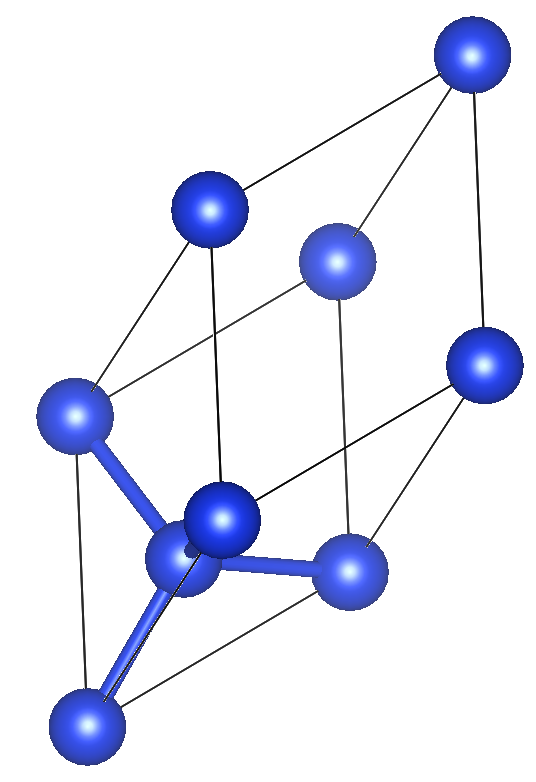
a = b = c = 3.836 Å
| kppvol | k-mesh |
|---|---|
| 0 | [1, 1, 1] |
| 20 | [4, 4, 4] |
| 40 | [6, 6, 6] |
| 60 | [7, 7, 7] |
| 80 | [7, 7, 7] |
| 100 | [8, 8, 8] |
| 120 | [9, 9, 9] |
| 140 | [9, 9, 9] |
| 160 | [9, 9, 9] |
| 180 | [10, 10, 10] |
| 200 | [10, 10, 10] |
| 400 | [13, 13, 13] |
| 600 | [15, 15, 15] |
| 800 | [17, 17, 17] |
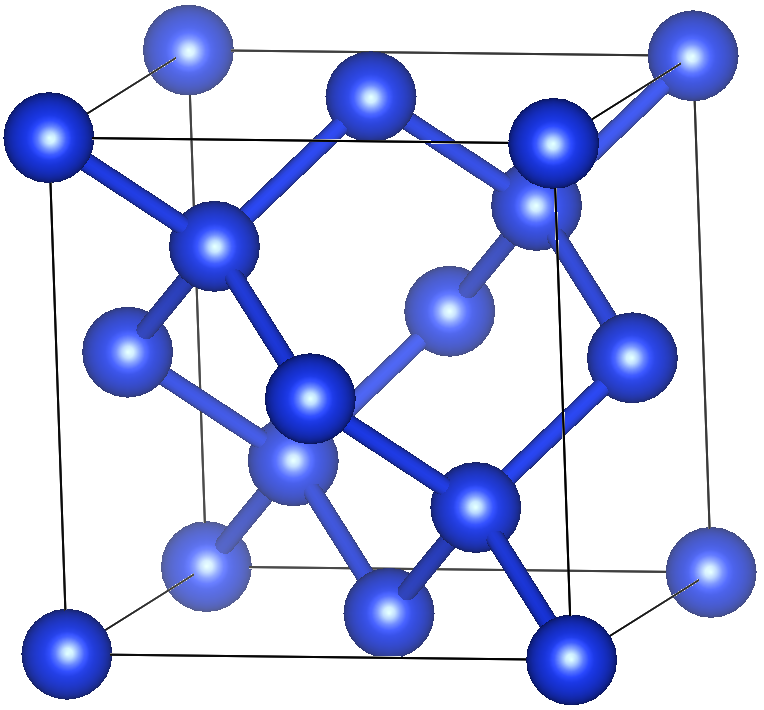
a = b = c = 5.431 Å
| kppvol | k-mesh |
|---|---|
| 0 | [1, 1, 1] |
| 20 | [3, 3, 3] |
| 40 | [3, 3, 3] |
| 60 | [4, 4, 4] |
| 80 | [4, 4 ,4] |
| 100 | [5, 5, 5] |
| 120 | [5, 5, 5] |
| 140 | [6, 6, 6] |
| 160 | [6, 6, 6] |
| 180 | [6, 6, 6] |
| 200 | [6, 6, 6] |
| 400 | [8, 8, 8] |
| 600 | [9, 9, 9] |
| 800 | [10, 10, 10] |
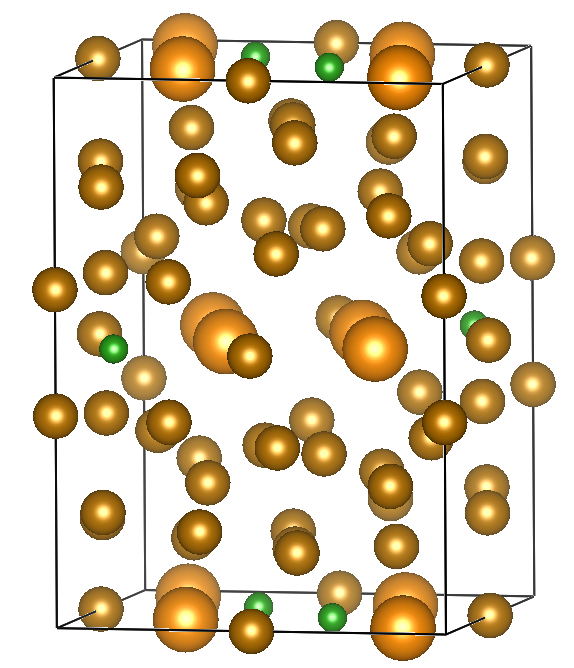
a = b = 8.804 Å
c = 12.205 Å
| kppvol | k-mesh |
|---|---|
| 0 | [1, 1, 1] |
| 20 | [1, 1, 1] |
| 40 | [2, 2, 1] |
| 60 | [2, 2, 2] |
| 80 | [3, 3 ,2] |
| 100 | [3, 3, 2] |
| 120 | [3, 3, 2] |
| 140 | [3, 3, 2] |
| 160 | [3, 3, 2] |
| 180 | [4, 4, 2] |
| 200 | [4, 4, 3] |
| 400 | [5, 5, 3] |
| 600 | [6, 6, 4] |
| 800 | [6, 6, 4] |