Permutation
Last updated: July 7, 2026
Overview
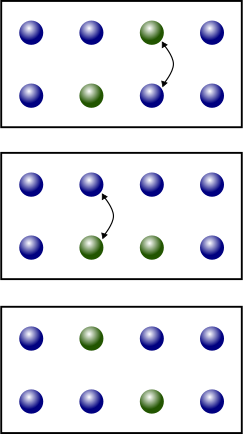
Permutation is an evolutionary operation that generates new structures (offspring) by modifying the atomic arrangement within a single structure. It enables the exploration of alternative configurations without changing the lattice or the overall composition.
How It Works
The positions of atoms of different elements are swapped.
The number of swaps can be specified by ntimes, which is set to 1 by default.
After performing ntimes swaps, the operation is retried if the resulting structure is identical to the parent.
Finally, the minimum interatomic distances are checked.